“If you want to find the secrets of the Universe, think in terms of energy, frequency and vibration.”

(Nikola Tesla)

Cells, electricity and biological organisation
The human body is composed of trillions of cells organised into tissues, organs and systems. From a biophysical perspective, living organisms can also be described as complex electrical systems, where atoms, ions and charged particles play a central role in cellular communication and organisation.
Atoms are composed of subatomic particles such as protons, neutrons and electrons. When an atom gains or loses electrons, it becomes an ion, acquiring an electrical charge that allows it to interact with other ions and form structured biological environments.
Ions and membrane potential
At the cellular level, ions carry electrical charge and their distribution across the cell membrane creates an electrical potential difference between the interior and exterior of the cell. This membrane potential is a fundamental bioelectrical parameter involved in cellular signalling, transport mechanisms and functional coordination.
Rather than being static, membrane potential is dynamic and continuously adapts to metabolic activity, energetic demand and environmental conditions.
Important note
This content is provided for educational and informational purposes only. It does not constitute medical advice, diagnosis or treatment.
Membrane potential as a bioelectrical reference
In biophysical research, membrane potential is widely studied as a reference parameter for understanding how cells adapt and respond to internal and external influences. Variations in electrical potential are associated with shifts in cellular behaviour, efficiency and communication, reflecting the cell’s capacity to maintain bioelectrical organisation.
The role of the internal environment
The extracellular environment — including electrolytes, minerals and available nutrients — contributes to the stability of bioelectrical balance. When this environment is coherent and well supported, cells are better able to sustain their natural cycles of activity, recovery and organisation.
Within a wellness and educational context, attention is placed on supporting conditions that favour balance, coherence and functional optimisation, without diagnosing or treating disease.
Cellular bioelectrical activity and membrane potential
From a biophysical perspective, the cell membrane potential is a key parameter used in research to describe the electrical state of a cell. It reflects the distribution of ions across the cell membrane and plays a role in cellular signalling, transport processes and energetic balance.
In bioelectrical studies, healthy and well-functioning cells are typically associated with a stable and well-regulated membrane potential, which supports efficient cellular activity and metabolic coordination. This electrical balance is closely linked to mitochondrial function, energy availability and the organisation of intracellular processes.
Membrane potential is not a fixed value. It naturally varies over time as cells adapt to metabolic demand, age, environmental conditions and external influences. In research contexts, variations in membrane potential are observed as indicators of changes in cellular efficiency, stress response and adaptive capacity.
Within an educational and wellness framework, membrane potential is used as a reference concept to understand how cellular environments, hydration, mineral balance and lifestyle factors contribute to bioelectrical organisation and functional coherence.
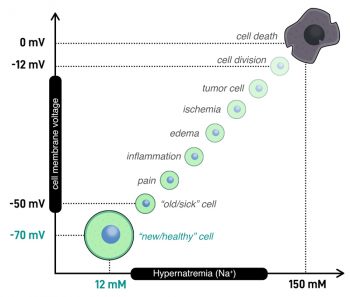
All diseases will relate to a value for cell membrane lost electrical potential.Variations in cell membrane potential are studied as indicators of changes in cellular bioelectrical organisation.
Within a wellness context, the practitioner’s role is to support conditions that favour bioelectrical balance, cellular coherence and functional optimisation.
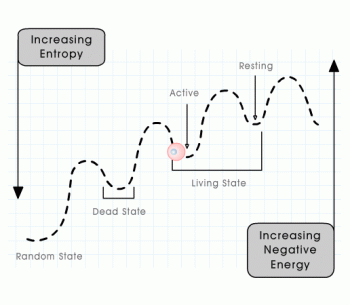
In biophysical terms, cellular activity involves natural cycles of electrical variation, including phases of depolarisation and repolarisation. These fluctuations reflect how cells adapt to metabolic demand, energetic activity and internal organisation over time.
Under balanced conditions, cells are able to regulate these electrical cycles efficiently, maintaining coherence between intracellular and extracellular environments. This dynamic equilibrium supports functional coordination and adaptive capacity at the cellular level.
When the extracellular environment — including electrolyte availability, mineral balance and nutrient presence — becomes less coherent, cells may show altered electrical regulation. In research contexts, such variations are studied as indicators of changes in bioelectrical organisation and adaptive efficiency, rather than as diagnostic markers.
Acid Medium vs. Alkaline Medium
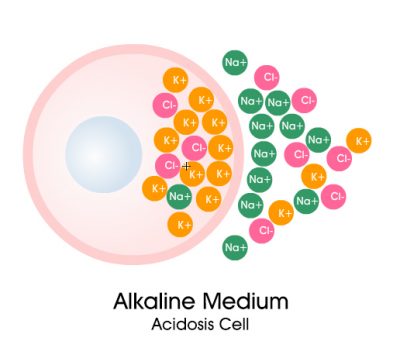
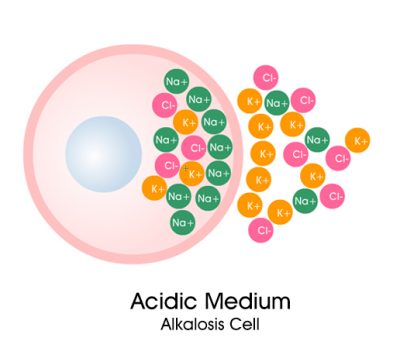
Within biophysical models, variations in the extracellular environment — including pH and electrolyte distribution — are studied as factors that influence cellular organisation and bioelectrical balance.
An extracellular environment that shifts towards higher acidity is associated, in research contexts, with changes in ionic availability and electrical coherence around the cell. These variations can affect how cells regulate exchange, signalling and adaptive processes.
In educational and wellness-oriented frameworks, attention is placed on understanding how hydration, mineral balance and lifestyle factors contribute to maintaining a more stable and coherent extracellular environment, without diagnosing or treating medical conditions.